AI Smart Robot Car: Mecanum Wheels + Robotic Arm
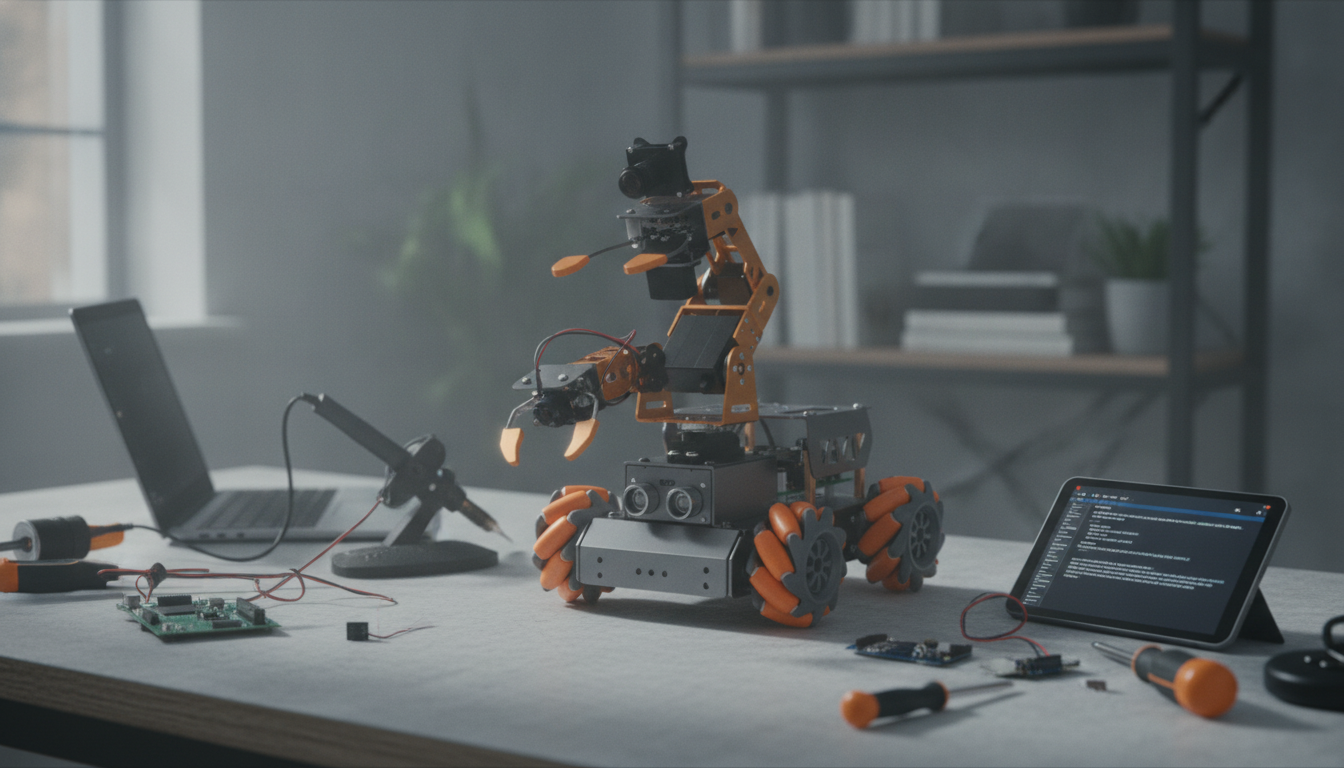
AI-Enhanced Smart Robot Car with Mecanum Wheels and Robotic Arm
An AI-enhanced robot car that combines omnidirectional mecanum wheels with a robotic arm is built for hands-on learning, prototyping, and practical manipulation tasks. It’s a compact platform that can drive in any direction in tight indoor spaces, then use an arm to interact with lightweight objects—making it a strong fit for STEM programs, computer-vision experiments, and small-scale “warehouse” simulations.
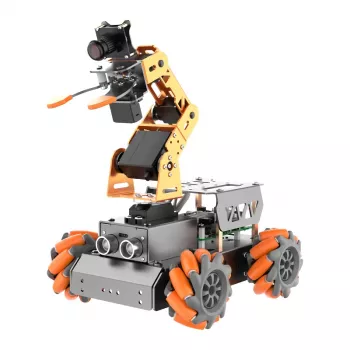
If you’re comparing platforms, start with a clear view of what you want the robot to do: smooth sideways movement for alignment, repeatable arm motion for pick-and-place, and AI features that run with stable latency. For a ready-to-build option, see the AI-Enhanced Smart Robot Car with Mecanum Wheels and Robotic Arm.
What this robot car is designed to do
This style of robot car is designed as a multi-skill learning system: you get motion control challenges (holonomic drive), manipulation challenges (arm kinematics and gripping), and perception challenges (camera/sensors and AI behaviors) in one chassis.
- Omnidirectional driving for tight indoor spaces: strafe left/right, move diagonally, and rotate in place to navigate around desks, bins, or mock shelving.
- Arm-assisted interaction: pick, place, push, and reposition lightweight objects for demos and training tasks.
- AI-enabled behaviors: autonomy features often include vision-based tracking, obstacle awareness, and route logic (depending on the included controller and software).
- Ideal use cases: STEM labs, hobby robotics, warehouse-style mini simulations, and computer-vision projects.
For teams that want to connect robotics to everyday mobility decisions and cost tradeoffs in a classroom setting, a complementary reading option is How Much Driving Makes a Car Worth It – Practical Guide to Decide How Often Do I Need to Drive to Justify a Car.
Why mecanum wheels matter for control and navigation
Mecanum wheels use angled rollers to generate forces in multiple directions, allowing the chassis to translate sideways without turning. That one change makes many robotics tasks easier: aligning a gripper to an object, docking to a bin, or “sliding” along a line of targets without repeated multi-point turns. For background, see Mecanum wheel.
- Omnidirectional mobility: side-to-side translation without changing heading.
- Smoother docking and alignment: easier to line up the arm with objects, markers, or bins.
- Tighter turning radius: rotate around the center point for precise positioning.
- Tradeoffs to plan for: mecanum systems typically need good traction surfaces and careful calibration to reduce drift.
Mecanum movement modes and what they’re good for
| Movement | How it moves | Best for |
|---|---|---|
| Strafe | Slides left/right without changing heading | Aligning the arm to a target; moving along shelves |
| Diagonal | Moves forward while shifting laterally | Navigating around obstacles in narrow aisles |
| Rotate in place | Turns around its center | Re-aiming sensors/camera; quick orientation changes |
| Micro-adjust | Small, slow corrections | Precise grasp approach and placement |
Robotic arm capabilities to pay attention to
The arm turns a “driving robot” into a “task robot.” For learning, consistency matters more than raw speed: stable mounting, repeatable servo positions, and a gripper that matches your typical objects will make projects far less frustrating.
- Degrees of freedom: more joints generally improve reach and approach angles for grasping.
- End effector: gripper design affects what can be held (blocks vs. cylinders vs. soft items).
- Reach and payload: practical payload is usually modest; plan projects around lightweight objects.
- Repeatability: consistent servo control and stable mounting matter more than raw speed for learning tasks.
- Safety and durability: torque limits, stall behavior, and mechanical stops help protect parts during testing.
A useful approach is to define a “standard object set” (foam blocks, small cartons, plastic cylinders) and evaluate grasp success rates across repeated trials. That gives immediate feedback on gripper geometry, center-of-gravity issues, and whether your alignment routine is robust.
AI features: what to verify before building projects
AI on a mobile manipulator is less about flashy demos and more about a reliable perception-to-action pipeline. Before committing to a project plan, confirm where inference runs, what sensors are included, and whether the software stack supports the workflows you want (data capture, labeling, training, and deployment).
For vision experimentation, many builders rely on proven libraries like OpenCV and robotics middleware such as Robot Operating System (ROS), especially when they want modular nodes for perception, control, and telemetry.
Setup and calibration checklist for reliable demos
Quick pre-run checklist
| Item | What to confirm |
|---|---|
| Drive calibration | Straight drive, strafe, and rotate are stable at low speed |
| Arm limits | No joint binds; home pose set; max angles defined |
| Grip test | Gripper closes evenly and can hold the project’s target objects |
| Power stability | No resets under combined drive + arm load |
| Failsafe | Emergency stop method or immediate shutdown procedure is ready |
Project ideas that fit mecanum drive + arm manipulation
FAQ
Can the robot car move sideways without turning?
Yes. Mecanum wheels use angled rollers that let the chassis translate left or right while keeping the same heading. Accuracy depends on traction, wheel installation orientation, and calibration to reduce drift.
What kind of objects can the robotic arm pick up?
Most kits are best with lightweight objects like foam blocks, small boxes, and plastic parts. Grip success depends on the gripper shape, object size, and surface material—smooth or soft items may need slower approaches and better alignment.
Does the AI run on the robot or need a computer?
It depends on the controller included with the platform: some run inference on-device, while others rely on a connected computer for processing. On-device inference usually reduces latency, while tethered setups can offer more compute at the cost of responsiveness and portability.














Leave a comment