YouTube Shorts Growth System: Hooks, Retention, Subscribers

Growing on YouTube Fast: A Practical YouTube Shorts Strategy to Boost Views, Subscribers, and Engagement
YouTube Shorts can work like a discovery engine: they put your channel in front of new viewers fast, then give you a chance to convert that attention into subscribers and long-term fans. The most reliable approach is less about “one viral hit” and more about a repeatable system—strong hooks, retention-focused pacing, clear calls to action, and a consistent posting rhythm you can actually maintain. For more guidance, see YouTube Marketing: I Went Through All the Steps to … – HubSpot.
What Makes a Short Take Off
Most breakout Shorts share a few traits that are easy to spot once you start looking for them: For further reading, see 15 Ways to Grow Your YouTube Channel | Digital Marketing Institute.
- Audience match: The topic and delivery instantly signal who it’s for and why it matters.
- Retention first: Fast pacing, frequent visual changes, and a clear payoff keep viewers watching.
- Replay potential: Dense value, satisfying loops, or a surprising ending encourages re-watches.
- Engagement triggers: A question, a choice, or a challenge can prompt comments without sounding forced.
- Consistency signals: Recurring themes and a recognizable editing style help viewers remember you.
Shorts distribution responds to behavior. When people watch longer, re-watch, and take an action (like subscribing or commenting), the platform has clearer signals to show your Short to more viewers.
Set Up a Simple Shorts Growth System
If you want predictable growth, build a system you can run weekly—then improve it with small, measurable changes.
- Pick 2–4 content pillars: Topics you can publish repeatedly without running out of ideas.
- Create 3 repeatable series formats: Examples: “3 mistakes to avoid…”, “Before/After…”, “Quick test: …”.
- Define one primary action per Short: Subscribe, comment, watch the next Short, or visit a long-form video.
- Batch production: Script 10 hooks at once, film in one session, edit in another, schedule in blocks.
- Track only a few metrics weekly: Average view duration, retention curve drops, shares, and subs gained.
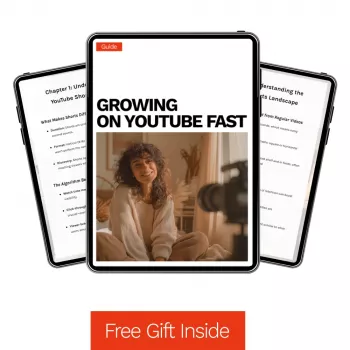
To keep your process organized, a structured resource like the YouTube Shorts growth guide to boost views, subscribers, and engagement can help you maintain a consistent routine for hooks, formats, posting plans, and review checklists.
Hook, Pace, and Retention: The Core Blueprint
Retention is the backbone of Shorts performance. If you improve it, you usually improve everything else.
- Open with an immediate promise or tension: Show the result first, or state the problem in one sentence.
- Cut anything that doesn’t earn attention: Aim for a new visual beat every 0.5–1.5 seconds.
- Use open loops: Tease a key detail, then resolve it later to prevent early drop-off.
- Keep audio clean: Clear voice, consistent volume, and captions that clarify rather than clutter.
- End with payoff or loop: A reveal, transformation, or a natural restart that encourages re-watches.
Retention Fixes for Common Drop-Off Moments
| Drop-off moment | Likely cause | Quick fix to test |
|---|---|---|
| First 1–2 seconds | Hook is vague or slow | Start with the outcome, add a bold claim, or show the most visual moment first |
| Midpoint | No progression or stakes | Add a step-by-step countdown, a comparison, or a “watch this part” open loop |
| Last 3 seconds | Ending feels complete too early | Move the payoff to the final second, add a quick twist, or build a clean loop ending |
Posting Rhythm and Idea Pipeline (Without Burnout)
Consistency matters, but sustainability matters more. A “perfect” week followed by silence usually loses to steady publishing that trains your audience what to expect.
- Start sustainable: 3–5 Shorts per week is a common baseline; scale up only when quality stays stable.
- Build an idea bank: Pull from comments, competitor gaps, recurring questions, community posts, and your own experiments.
- Rotate formats: Prevent viewer fatigue while keeping the same pillars for clear channel identity.
- Plan weekly mixes: 3 discovery Shorts (broad), 1 authority Short (deep tip), 1 conversion Short (subscribe/watch next).
- Keep evergreen backups: A few ready-to-post Shorts for busy weeks reduces pressure and prevents gaps.
If you’re learning the basics of Shorts creation or want to confirm formatting requirements, YouTube’s official documentation is the best reference: YouTube Help Center — Create Shorts.
Turn Shorts Views Into Subscribers and Long-Term Growth
Practical Guide for Faster Shorts Growth
If you want a step-by-step framework to organize hook templates, retention editing patterns, series planning, and conversion prompts, consider Growing on YouTube Fast: Ultimate YouTube Shorts Strategy for Growth Guide – Boost Views, Subscribers & Engagement (USD 8.99). It’s built to help you run Shorts like a repeatable system rather than guessing post to post.
Creators also benefit from decision frameworks beyond YouTube—especially when time, budget, or logistics affect production. If you’re weighing practical trade-offs (like whether a dedicated vehicle or frequent travel actually makes sense for your routine), How Much Driving Makes a Car Worth It – Practical Guide to Decide How Often Do I Need to Drive to Justify a Car (USD 11.99) is a straightforward way to sanity-check recurring costs versus real usage.
Troubleshooting: When Shorts Stall
FAQ
How many Shorts should be posted per week to grow faster?
A sustainable starting range is 3–5 Shorts per week. Increase only after you can maintain quality and your analytics (especially average view duration and retention) stay stable as volume rises.
Do hashtags and descriptions matter for Shorts?
They help provide context and organization, but they won’t compensate for a weak hook or poor retention. Use a few highly relevant hashtags/keywords and keep descriptions clean and specific.
Why do Shorts get views but not subscribers?
Usually the channel promise isn’t clear, the topics are inconsistent, or the call to action is generic. Improve pillar consistency, build ongoing series, and use a specific “subscribe for X” value so viewers know what they’ll get next.















Leave a comment