4-Week At-Home Workout Plan: Daily Strength & Mobility

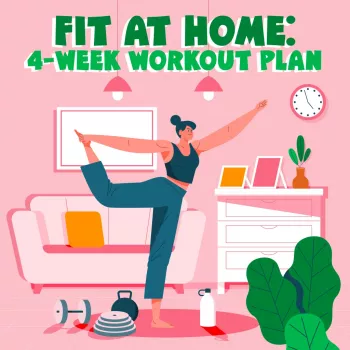
Fit at Home: A 4-Week Minimal-Equipment Workout Plan with Daily Workouts and Stretches
A consistent home routine can build strength, improve mobility, and support better energy without needing a full gym setup. This guide lays out a practical 4-week structure—daily workouts plus stretches—designed for small spaces and minimal equipment, with clear progression and built-in recovery.
What’s Included in a 4-Week At-Home Routine
This plan uses a simple daily rhythm so you always know what to do next. Strength days build full-body muscle and joint resilience; mobility days keep movement smooth; light conditioning days raise your heart rate without requiring a treadmill.
- Daily structure: strength, mobility, and light conditioning balanced across the week.
- Minimal equipment approach: bodyweight-first with optional add-ons (bands, a light dumbbell or kettlebell).
- Progression plan: week-to-week increases in reps, time-under-tension, or rest control—no complicated programming.
- Recovery included: dedicated mobility and stretching to reduce soreness and maintain range of motion.
- Beginner-friendly options: easier variations for common moves (incline push-ups, supported squats, shorter intervals).
Minimal Equipment Checklist (and Smart Substitutions)
You can do the full month with the basics: comfortable clothing, a stable chair/bench, and an exercise mat (or a folded towel). If you have a band or a single weight, great—but household items can work surprisingly well.
| If You Have… | Use It For… | If Not, Substitute… |
|---|---|---|
| Resistance band | Rows, pull-aparts, glute kickbacks | Towel isometrics against a door (safe anchor) or backpack rows |
| Dumbbell/kettlebell | Goblet squats, hinges, carries | Backpack loaded with books |
| Slider discs | Mountain climbers, ham curls | Socks on a smooth floor |
| Bench/step | Step-ups, incline push-ups | Sturdy chair (non-wheeled) |
Space needs: aim for an area about the size of a yoga mat plus arm reach so you can hinge, squat, and plank safely.
Daily Flow: Warm-Up, Main Set, Cooldown
Warm-up (5–8 minutes)
Keep it brisk and joint-friendly: neck/shoulder circles, marching in place, hip hinges, squat-to-stand, and shoulder openers. You should feel warmer and looser, not tired.
Main set (12–25 minutes)
Most sessions work best as circuits or paired movements (push/pull, squat/hinge, core/carry). Use an intensity guide of stopping about 1–3 reps shy of failure on most sets, saving “hard” efforts for controlled intervals.
Cooldown (5–10 minutes)
Finish with a breathing downshift (slow nasal breathing if possible) and gentle stretches for hips, calves, chest, and upper back. This is where stiffness tends to drop the most over time.
For general activity targets that support heart and joint health, the CDC Physical Activity Guidelines are a helpful reference point. For strength work, you can also compare your weekly routine to ACSM resistance training recommendations.
4-Week Weekly Schedule (Progressive and Repeatable)
Each week keeps the same “map,” so you build skill through repetition while still progressing. Week 1 is about learning and establishing a baseline. Week 2 adds volume. Week 3 nudges difficulty. Week 4 consolidates—quality first, with mobility prioritized.
| Day | Focus | Example Main Work (Minimal Equipment) | Stretch Emphasis |
|---|---|---|---|
| Day 1 | Full-body strength | Squat pattern + push + row + core (circuits) | Hips + chest |
| Day 2 | Mobility + light cardio | Low-impact intervals (marching, step-ups) + mobility flow | Calves + hip flexors |
| Day 3 | Lower body + core | Hinge pattern + glutes + anti-rotation core | Hamstrings + glutes |
| Day 4 | Upper body + posture | Push-ups/incline press + band/towel rows + shoulders | Upper back + pecs |
| Day 5 | Conditioning | EMOM or intervals: squats, mountain climbers, carries | Full-body reset |
| Day 6 | Full-body strength (variation) | Unilateral work (split squats) + overhead press variation | Adductors + lats |
| Day 7 | Recovery | Easy walk + mobility + breathing | Longer holds (30–60s) |
Recovery note: even “rest” days benefit from a short walk and a few mobility drills. That’s often what keeps the next strength session feeling good.
Progress Without Guesswork: Simple Ways to Level Up Each Week
Stretching and Mobility: What to Do After Each Session
If you want additional examples of strength-and-flexibility moves, the NHS strength and flex exercises guide is a solid companion reference.
Who This Works Best For (and How to Adjust)
Printable Plan Option: Daily Workouts and Stretches in One Place
- Fit at Home: 4-Week Workout Plan (PDF with daily workouts and stretches)
- For a simple recovery upgrade at home (reading, breathing work, or longer post-workout cooldowns), consider a comfortable, supportive seat like the Elegant Ebony Genuine Leather Rocking Chair.
FAQ
How long should each at-home workout take with a minimal-equipment plan?
Most sessions fit well into 20–40 minutes total: 5–8 minutes to warm up, 12–25 minutes for the main set, and 5–10 minutes to cool down. To shorten to 15–20 minutes, reduce the number of rounds and keep the cooldown to a few key stretches.
Is a 4-week home workout plan enough to see results?
Yes—many people notice improvements in strength, stamina, and mobility within a few weeks when workouts are consistent and progressively challenging. Results are easiest to sustain when sleep, protein intake, and overall daily movement support the training.
What if there’s no room or equipment for cardio at home?
Use low-impact options like marching in place, step-ups on a sturdy chair/step, or interval walking in a hallway or around your home. You can scale intensity by shortening rest, extending intervals, or adding loaded carries with a backpack instead of jumping.















Leave a comment