Tame Your Inner Critic: Stop Negative Self-Talk Gently

Why the Inner Critic Feels So Convincing
An inner critic is that internal voice that narrates your flaws as if it’s reporting facts: “Not good enough,” “You’ll mess it up,” “Everyone else has it together.” It can feel personal and absolute, but it’s usually an internalized mix of past experiences, cultural messaging, and learned standards—not an objective narrator.
It also has biology on its side. The brain’s threat system is designed to scan for what could go wrong, which can make negative thoughts feel urgent and “true,” even when they’re exaggerated. In practice, the critic often plays familiar roles: the Perfectionist who won’t let you start, the Mind Reader who predicts rejection, the Catastrophizer who turns one mistake into a disaster, the Taskmaster who demands constant output, and the Shame Spiral that frames normal human imperfection as a character defect.
Healthy self-evaluation is specific and actionable (“I rushed that slide; I’ll simplify the next one”). Inner-critic attacks tend to be global, moralizing, and vague (“I’m pathetic,” “I never do anything right”). The goal isn’t to remove accountability—it’s to replace punishment with clarity.
Recognizing Your Critic’s Patterns: Triggers, Themes, and Tells
The inner critic gets loud in predictable moments: starting something new, being seen (presentations, dating, social media), receiving feedback, resting, navigating conflict, or sitting in uncertainty. Underneath, the theme is often safety—your mind trying to prevent embarrassment, rejection, or failure by pushing you to control outcomes.
Patterns also show up in the body. A tight chest, shallow breathing, clenched jaw, nausea, or a sudden urgency to “fix” everything can signal that the critic is in the driver’s seat. Instead of arguing with the thought, start by noticing its distortions: all-or-nothing thinking, overgeneralizing, labeling, and emotional reasoning (“I feel anxious, so it must be dangerous”). Naming the pattern creates a gap where choice can return.
Inner critic patterns and kinder alternatives
| What the critic says | Hidden fear/need | A more supportive response | One small next step |
|---|---|---|---|
| “If it’s not perfect, don’t start.” | Fear of failure or judgment | “Starting messy is how progress happens.” | Set a 10-minute ‘draft only’ timer. |
| “You always mess things up.” | Need for safety and predictability | “One mistake doesn’t define the whole story.” | List 2 past times you recovered well. |
| “They’ll think you’re stupid.” | Need for belonging | “I can’t read minds; I can stay present.” | Prepare 1 clarifying question to ask. |
| “Rest is lazy.” | Fear of falling behind | “Rest supports consistency.” | Schedule a 15-minute recovery break. |
| “You don’t deserve good things.” | Old shame/wounds | “I’m learning to treat myself with basic respect.” | Do one self-respecting action (water, meal, tidy space). |
The Most Helpful Mindset Shift: From Fighting the Critic to Understanding It
A powerful shift is moving from “I must defeat this voice” to “What is this voice trying to protect me from?” The inner critic is often a protective strategy that became overactive. Its method is harmful, but its aim is usually safety: avoid mistakes, avoid rejection, avoid pain.
Try “name it to tame it.” When you notice the tone, label it: “That’s the Taskmaster,” or “That’s the Catastrophizer.” Labeling reduces fusion—so you can respond rather than react. Instead of getting into a power struggle with thoughts, focus on changing your relationship to them. This approach aligns with evidence-based methods used in therapies like Cognitive Behavioral Therapy and Acceptance and Commitment Therapy (see the American Psychological Association’s overview of CBT and the Association for Contextual Behavioral Science resources on ACT).
Practical Tools to Stop the Spiral in the Moment
1) A 60–90 second grounding reset
2) Cognitive defusion: add one sentence
3) A compassionate reframe that stays honest
4) Replace global labels with specifics
5) Two-column rewrite: Critic vs. Coach
Building a Daily Practice That Makes Supportive Self-Talk Stick
Environment design helps, too: templates, checklists, and scheduled focus blocks reduce decision fatigue. If stress runs high, consider self-help resources that normalize practical coping skills, such as the NHS guide on self-help for stress, anxiety and depression.
When the Inner Critic Points to Something Deeper
A Structured Resource for Emotional Growth and Gentler Self-Talk
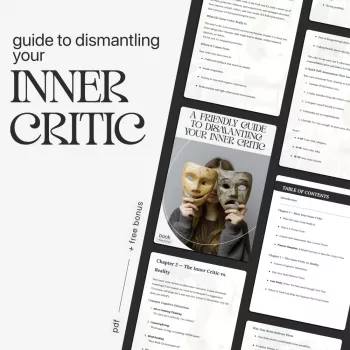
If a step-by-step format helps you stay consistent, a guided resource can make the practice feel less abstract. A Friendly Guide to Dismantling Your Inner Critic (Digital eBook) is designed to help you identify your specific inner-critic patterns and practice new responses in a repeatable way—without forcing fake positivity.
If practical guides are your preferred learning style in general, you may also like How Much Driving Makes a Car Worth It – Practical Guide to Decide How Often Do I Need to Drive to Justify a Car for the same “clear steps, less overthinking” approach—applied to everyday decisions.
FAQ
Why is my inner critic louder when I’m trying to improve my life?
Growth involves uncertainty and visibility, which can activate the brain’s threat response and old protective strategies. When you’re stretching into new territory, the critic may get louder to push you back toward what feels familiar. Grounding and taking smaller, repeatable steps can help your nervous system recalibrate.
How can I stop negative self-talk without pretending everything is fine?
Acknowledge what you feel, then shift into supportive realism: “I’m having the thought that…” and “What’s one specific next step?” You don’t have to agree with the critic or argue with it; you can respond with honest coaching that keeps you moving.
How long does it take to change an inner critic habit?
It’s usually gradual—measured in noticing sooner, recovering faster, and choosing kinder language more often. Daily micro-practices build momentum, and tracking evidence of progress helps counter the critic’s selective attention. If shame stays intense or persistent, extra support can speed up healing.














Leave a comment