Work-Life Balance System for Busy Professionals

Mastering Work and Wellness in the Modern World: A Practical System for Busy Professionals
Modern work rewards speed, availability, and constant context-switching—often at the expense of sleep, movement, and mental clarity. The goal isn’t a perfect routine; it’s a repeatable system that protects energy, reduces stress spikes, and keeps productivity sustainable. Below is a structured approach to building boundaries, planning days that actually fit, and using simple tools to make balance measurable instead of wishful.
What “balance” looks like in a digital-first career
Balance is less about equal hours and more about capacity management: aligning workload with realistic limits for sleep, recovery, and attention. In a digital-first role, three friction points usually drive the most strain: always-on communication, blurred home/work boundaries, and decision fatigue from a nonstop stream of small choices.
Early warning signs are often subtle at first: irritability, shallow sleep, procrastination, frequent “catch-up” nights, and reduced motivation. A more useful target than “work-life balance” is stable output with predictable recovery—work that feels steady rather than spiky, with fewer emergencies created by overcommitment.
Set non-negotiables: the minimum wellness floor
When schedules get packed, wellness tends to become optional—until performance drops. The fix is a minimum viable wellness floor: the smallest set of habits you can repeat even on busy weeks. Once the baseline is consistent, upgrades become easier and less fragile.
| Area | Baseline (daily) | Upgrade (2–3x weekly) |
|---|---|---|
| Sleep | Same wake time; 20–30 min wind-down | Earlier bedtime by 30–60 min on high-demand weeks |
| Movement | 10–20 min walk or mobility | 30–45 min strength or cardio session |
| Nutrition | Protein + fiber at first meal; water with each meeting break | Batch prep 2 staples (grain/protein/veg) |
| Stress reset | 5 min breathing or journaling after work | Longer reset: nature walk, yoga, or therapy/coaching session |
Think of the floor as insurance. A consistent wake time, a short walk, and a simple first meal often do more for sustainable energy than an ambitious plan that collapses under pressure.
Design the workday around energy, not the clock
A packed calendar doesn’t mean a productive day. Start by mapping tasks by cognitive load: deep work (analysis, writing, building), admin (forms, scheduling), communication (email, chat), and creative problem-solving (brainstorming, strategy). Then match tasks to your attention.
- Use focus blocks that fit real attention spans: 25–50 minutes of work with short breaks.
- Reserve peak hours for one high-impact task; protect it from meetings and notifications.
- Batch shallow work into defined windows so it doesn’t leak into everything else.
- Add 5–10 minute transition buffers between meetings to reduce stress accumulation.
One practical rule: if a meeting ends at :30, don’t schedule the next one until :40. That tiny gap prevents the “running late” spiral and gives your nervous system a chance to downshift.
Boundaries that hold: communication rules and device hygiene
Boundaries work best when they’re clear, consistent, and easy for others to follow. Define availability windows for email or chat and share them proactively (status message, calendar notes, or a simple line in your email signature). Pair that with a shutdown ritual to create a clean end to the workday: final inbox sweep, write tomorrow’s top three priorities, then close the laptop.
- Notification triage: turn off non-urgent alerts; keep only truly time-sensitive channels.
- Protect mornings and evenings with phone-free bookends or limited app sets.
- Create escalation paths: what requires a call/text vs. what can wait in a message.
These shifts reduce the “always on” load that workplace stress experts consistently flag as a driver of burnout and health risk. For additional background, see the NIOSH guidance on stress at work and the American Psychological Association resources on workplace stress.
A weekly planning system that reduces stress before it starts
When sleep is the first thing sacrificed, everything else gets harder. The National Sleep Foundation offers practical sleep-health education that pairs well with a consistent weekly plan.
Stress management tools for real-world constraints
Putting it all together with guided tools and supportive products
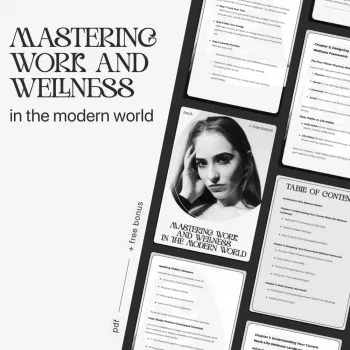
A structured guide can turn good intentions into a repeatable routine by prompting workload review, boundary setting, stress triggers, recovery planning, and progress tracking. For a step-by-step framework that works well as a 4-week reset (baseline, boundaries, work design, maintenance), consider the digital planner eBook: Mastering Work and Wellness in the Modern World | How to Balance Work and Wellness eBook for Professionals | Digital Life Balance Guide & Stress Management Planner.
Environment also matters. If evening decompression is a weak spot, a comfort-first setup can make shutdown rituals easier to keep. A dedicated recovery seat in a quiet corner can become a consistent cue to downshift, such as the Elegant Ebony Genuine Leather Rocking Chair. And for a restorative hobby that pulls attention away from screens, consider building a device-free block around something immersive like stargazing with the 200/2400mm High-Power Astronomical Telescope for Stargazing Enthusiasts.
FAQ
How long does it take to notice improvements in work and wellness balance?
Small improvements often show up in 1–2 weeks, like more consistent sleep and fewer stress spikes. More durable routines typically take 4–8 weeks of repeatable planning and boundary practice.
What if the job requires being available after hours?
Set an escalation policy that defines what “urgent” truly means and which channel to use (call/text vs. message). Protect at least a few device-free blocks each week and compensate with scheduled recovery time so availability doesn’t become nonstop.
How can stress be reduced without cutting productivity?
Batch communication, protect deep work, shorten task cycles, and use checklists for repeatable workflows. When sleep and movement basics are consistent, focus improves and output quality tends to rise even if hours don’t.















Leave a comment