Find Your Quiet Compass: Beliefs, Journaling & Mindset

A steady sense of direction rarely arrives as a loud revelation. More often, it’s a quiet inner signal shaped by beliefs, values, and the stories repeated over time. This guide frames self-discovery as a practical process: noticing patterns, questioning assumptions, and using journaling to build a mindset that supports calm decisions and lasting personal growth.
What the “quiet compass” actually points to
The inner compass isn’t a single emotion, gut feeling, or sudden spark of motivation. It’s a blend of values (what matters), needs (what’s required to function well), boundaries (what’s not acceptable), and long-term priorities (what you’re building toward). When those four parts are aligned, decisions tend to feel simpler—even when they’re hard.
One useful distinction: intuition tends to be calm and consistent, while reactivity is urgent and fear-based. Intuition can still ask you to do uncomfortable things, but it usually doesn’t shout. Reactivity, on the other hand, often sounds like pressure, catastrophe, or a demand to “fix this now.”
Common noise sources that drown out internal cues include comparison, perfectionism, information overload, and chronic stress. If any of these are high, your “compass” may still be there—you’re just trying to read it in a storm.
Try a simple check-in before committing: “What feels aligned, sustainable, and respectful of boundaries?” If the choice honors your values but destroys your capacity, it may be more performance than alignment.
Quick alignment check: signal vs. noise
| Experience | Often feels like | Helpful response |
|---|---|---|
| Aligned inner signal | Steady, clear, grounded even if uncomfortable | Name the value being honored; take one small next step |
| Fear-based urgency | Racing thoughts, pressure to decide immediately | Pause; breathe; delay non-urgent decisions; seek more information |
| People-pleasing | Guilt, worry about disappointing others | Review boundaries; ask “What would be fair to both sides?” |
| Perfectionism | All-or-nothing thinking, harsh self-talk | Choose a “good enough” draft action; set a time box |
| Burnout signal | Numbness, irritability, low motivation | Reduce load; prioritize rest; simplify goals |
Beliefs that shape self-discovery (and how to test them)
Beliefs often run quietly in the background, shaping what feels possible, safe, or “allowed.” To spot invisible beliefs, listen for repeated thought-starters like “I should…,” “I always…,” or “If I don’t…, then…”. These phrases tend to reveal rules you’re living by—sometimes without choosing them.
Next, distinguish inherited beliefs (picked up from family, school, culture, or past relationships) from chosen beliefs (values you intentionally adopted). Inherited beliefs aren’t automatically wrong; they’re simply worth re-evaluating. A belief can be familiar and still misaligned.
To test a belief with evidence, write three short lists: (1) facts that support it, (2) facts that contradict it, and (3) the cost of keeping it. Costs can be emotional (anxiety), relational (resentment), or practical (missed opportunities). This structure helps reduce mental distortion and black-and-white thinking—patterns recognized in psychological research on cognitive distortions (APA Dictionary of Psychology).
Then, replace rigid beliefs with flexible alternatives: “Sometimes…,” “I’m learning…,” or “This is one chapter…”. Flexibility doesn’t mean lowering standards; it means leaving room for reality, recovery, and growth.
Finally, use a values lens: does the belief move life toward meaning, connection, health, or integrity? If it consistently moves you toward shrinking, hiding, or performing, it’s likely noise—not guidance.
Journaling that builds clarity instead of overthinking
Close with self-compassion to reduce rumination and support follow-through. Mindfulness-based approaches often emphasize returning to the present with less self-attack, which can improve emotional regulation over time (American Psychological Association: Mindfulness).
Mindset practices that keep the compass steady
Using the eBook as a guided path (digital download)
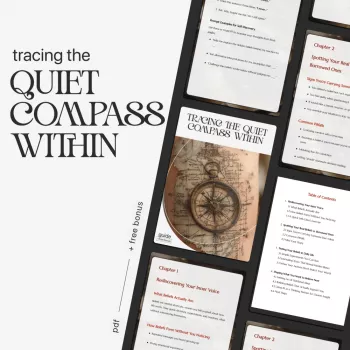
If you want more structure than open-ended journaling, a guided format can keep you moving without getting stuck in analysis. Tracing the Quiet Compass Within – Self-Discovery Beliefs Guide, Journaling & Mindset eBook, Personal Growth Digital Download is designed as a structured companion for beliefs exploration, journaling consistency, and mindset reinforcement.
For a calm environment that makes reflection easier, consider building a small ritual: a quiet corner, a consistent time window, and a comfort cue like a supportive seat. Some people prefer a soothing, anchored spot such as the Elegant Ebony Genuine Leather Rocking Chair. If reflection feels easier when your mind expands beyond day-to-day concerns, an occasional “zoom out” practice—like stargazing—can help; the 200/2400mm High-Power Astronomical Telescope for Stargazing Enthusiasts can support that kind of reset.
Suggested 14-day rhythm
| Days | Focus | Simple outcome |
|---|---|---|
| 1–3 | Baseline: values, current stressors, and what feels misaligned | Clear starting point and one boundary to practice |
| 4–7 | Beliefs audit: name, test, and soften one limiting belief | One updated belief statement to rehearse |
| 8–10 | Decision clarity: options, trade-offs, and next right step | One concrete action scheduled |
| 11–14 | Integration: weekly review and habit reinforcement | Personal “compass rules” for future choices |
Who benefits most—and when to pause and seek support
FAQ
How long should a daily journaling session be for self-discovery?
Five to fifteen minutes is usually enough when you use a timer and a focused prompt. Prioritize consistency, and end with one closing line that names a next step so the entry doesn’t turn into rumination.
What if a belief feels true even when evidence is mixed?
Treat the belief like a hypothesis: list costs and benefits, then rewrite it in a more flexible form (for example, “Sometimes…” or “I’m learning…”). Test it with a small real-world experiment and track what actually happens.
Is a digital download eBook useful without printing?
Yes—many people annotate the PDF directly, copy prompts into a notes app, or use templates for repeatable entries. The biggest advantage is searchability, making it easier to review patterns and summarize progress week to week.














Leave a comment